Restoring Eyesight

With Cataract Surgery

Are you suffering from blurred or dim vision?  Glare while driving at night or in the snow?  You may have a cataract, which is a clouding of the human lens of your eye.

Treatment options for cataracts include glasses and surgery.  A mild cataract may be treatable by simply updating your glasses prescription.  If your cataract is not amenable to treatment conservatively with glasses, surgery may be recommended.

Visit us today for your cataract treatment!

Dr. John Thayer has performed thousands of successful cataract surgeries with intraocular lens implants.

Cataract surgery is usually a five to ten minute procedure that Dr. Thayer performs at an Ambulatory Surgery Center in Springfield.  During surgery, Dr. Thayer will remove the lens of your eye and replace it with an Intraocular Lens, also known as an IOL.

The type of cataract surgery Dr. Thayer performs takes full advantage of modern technological advances.  This includes small incision, no-stitch wound architecture; use of ultrasound phacoemulsification to remove the cataract; use of antibiotic within the eye to reduce risk of infection; and leveraging implants of steroid emitting inserts to reduce drop burden post-operatively.

IOL’s offer the opportunity to correct existing refractive errors that may have required glasses.  Dr. Thayer has years of expertise in IOL selection and implantation.  His expertise extends to standardToric ( for correction of astigmatism), Trifocal (Panoptix), and Extended Depth of Focus lenses (EDOF, Vivity).

Normal VisionCataract Vision

informational videos about cataract surgery

What To Expect with Cataract Surgery

Dr Thayer Doing Cataract Surgery

The Argos

accuracy & excellence

The Argos is a key to our success in cataract surgery. In order to achieve accurate outcomes when implanting intraocular lenses (IOL’s), one must have an extremely accurate way of predicting what IOL power to use during surgery. The Argos is the best tool available for the purpose, delivering exceptionally accurate axial length, anterior chamber depth and lens thickness by optical biometry. The ARGOS is the choice for surgeons implanting torics and other premium IOLs where highly accurate outcomes are critical for success.

After Cataract Care

after your cataract laser surgery

After Cataract (Posterior Capsular Opacification)

The most common “complication” of cataract surgery is clouding of the capsule that houses your intraocular lens (IOL). Technically, this is known as posterior capsule opacification, or after-cataract. It occurs in about 10% or so of cataract patients, usually within the first two after surgery.

Symptoms are a painless loss of visual clarity, often described as a film over the vision.

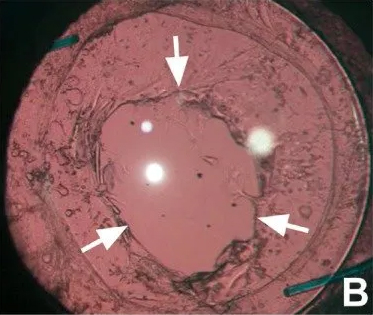
Fortunately, treatment is simple, short and painless. A YAG laser is used to cut a central opening in the opacified capsule. The photo above shows the opacified posterior capsule before laser (A), and after laser (B). The outline of the window cut with the laser is shown by the arrows in photo B.

After the laser is done, you may see a floater in your eye for several weeks as the piece of capsule that was cut away shrivels and drops lower into the back of your eye.

Dr. Thayer has the laser to perform this right in the office, eliminating your need to go to a surgery center to have this performed.

Cataract and Cataract Surgery

Frequently asked questions

Cataract surgery is usually elective. That means it is up to the patient whether and when to have it done. Vision may continue to decline until surgery is done.

Cataracts are the leading cause of blindness in the world.

This depends on your choice of intraocular lens, your lifestyle, and your eye’s anatomy. For more detail, please see the IOL page.

You will use drops to prevent infection and to reduce inflammation for  three to four weeks after surgery.  If you are diabetic, you may need drops for six weeks after surgery.

Assuming your surgery can be done in the typical fashion, using a small incision, you will be told not to swim for two weeks, not to rub the eye hard, and not to wear eye liner for two weeks after surgery.  It is perfectly fine for patients with small incision surgery to bend over, lift objects, and be physically active after surgery.

You will be restricted from driving for 24 hours after surgery due to the anesthesia you receive.  After that, you may operate a vehicle assuming your vision is good enough to legally do so.

Dr. Thayer does NOT use a laser during cataract surgery.  Laser assisted cataract surgery helps surgeons to make consistently sized and centered openings in the capsule to approach the cataract, and also helps with the initial incision into the eye.  These skills are particularly important when implanting premium lenses.  For surgeons who have not fully developed these skills, the laser can be helpful, although it is not a panacea.  Having done literally thousands of cataract surgeries, Dr. Thayer is confident of his mastery of the tasks the laser helps to perform.  In Dr. Thayer’s practice, using the laser would subject patients to an unnecessary extra cost that has never been shown to make any meaningful difference in the outcome of cataract surgery when that surgery is performed by a skilled surgeon to begin with.

Surgery is performed at the Surgery Center of New England in Springfield.

Surgery typically takes five to ten minutes.

Most patients receive concious sedation, which places them into a dream-like state in which they are still breathing on their own, but are unaware of or indifferent to their surroundings.  Most patients do not remember their surgery.  On the rare occassion, a patient may be put to sleep for surgery.

Cataract surgery is performed on an anesthetized eye and does not hurt.  If a patient does have discomfort during surgery, additional anesthesia or sedation may be given.

In 99% of cases, Dr. Thayer uses what is known as topical anesthesia. This uses drops to numb the eye, with an injection of a numbing agent into the front of the eye once the cataract wound has been created. Rarely, Dr. Thayer may ask the anesthesiologist to perform a “block,” which uses a needle to inject anesthetic around the eye. Blocks do increase risk as perforations of the eye are possible, and this is why Dr. Thayer performs them quite rarely.

Occasionally – if the cataract is interfering with the management of another eye condition, such as diabetic eye disease, or if the cataract is causing problems with eye pressure or inflammation.

It can be.  If your cataract is at an advanced stage, removing it may become more difficult as it will require more ultrasound energy and could put you at increased risk.  Those risks can include corneal swelling, the need to perform an older style of surgery to remove the cataract, the inability to place an intraocular lens into the ideal position in the eye, and the need for follow-on surgery.